

According to the article Stage 4 in the Design Thinking Process: Prototype, prototyping is a necessary step in the design process and without it results can be below average. Prototyping is a way to turn ideas into reality and see how they would function in the real world. There are two types of prototyping, low and high fidelity. The most commonly used way is low fidelity prototyping because it is cheap and quick. With this style, designers can prototype and easily remake their prototypes into their desired product. After testing and beginning to gain the desired prototype, designers can begin to make more complex prototypes closer to their ideal version.
Prototyping allows us to learn more about our users and circle back to the previous steps of the design process. If a prototype isn’t working out the way it is expected to, then designers can go back and ideate to come up with solutions to the issues. Creating a prototype and observing how the user interacts with it allows designers to learn more about the user that wasn’t known before. The article Design Thinking: Get Started with Prototyping shows that prototyping is crucial when it comes to learning and understanding the user. It also shows that this exploration can lead to inspiration and motivation for the designer to empathize and ideate further. This is a learning by doing scenario that allows visualizations to come to life and designers to learn how their product will succeed day to day.
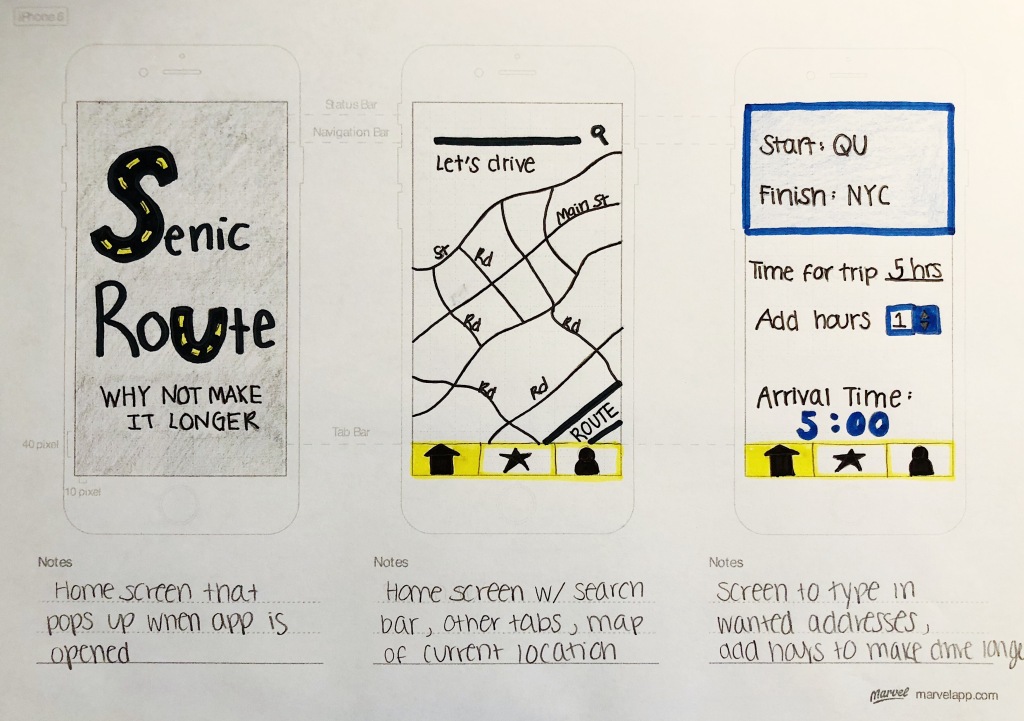
During the week of prototyping, in class, we were asked to use our final idea for our wacky app and create a working app prototype to go along with it. We were given sheets of paper with phone screen layouts to sketch out our screens. The picture above is a set of some of the screens I included in my wacky app. As designers, even while sketching we had to make sure to pay attention to detail because this step was an important part of the prototyping process. The app we used to create the working prototype is called Marvel. This app allowed us to take a picture of our hand-drawn screens and translate them into functioning app screens. We were required to add links to different sections of our screen in order for the screens to switch between one another. While I was doing this, I began to realize the tedious work that goes into apps and how each little part of a screen needs to be accounted for. Even though this was just a prototype, there was a good amount of time and work put into it.
The prototyping process allows designers to redefine their problem and gain a further understanding of the user. It is an important step that transforms ideas into reality and shouldn’t be skipped. Prototypes can lead to further testing to allow the product to become the best it can be. This step allows designers to have research across multiple interfaces and forms of media. Prototyping has helped to create the majority of products that exist today.
#designresearch



 SHANNON'S DESIGN BLOG